Disassembly Investigation of Batteries and Capacitors,
Investigation for Deterioration and Defect,
and Structural Analysis
In-situ Analysis During Charge and Discharge
ページ内メニュー
In-situ analytical techniques are powerful tools for elucidating structural and compositional changes caused by electrode reactions during charge and discharge, as well as the mechanisms responsible for battery degradation.
We offer a wide range of in-situ observation and analysis techniques, including X-ray diffraction (XRD) measurements during charge and discharge, scanning electron microscope (SEM) observation of all-solid-state batteries, thermal analysis for highly sensitive detection of localized abnormalities, evolved gas analysis, and optical microscopy. These techniques enable real-time observation and analysis of battery behavior under actual operating conditions.
In-situ XRD Analysis (X-ray Diffraction)
-
By using a dedicated cell equipped with a beryllium (Be) window, structural changes in electrode active materials can be observed and analyzed in situ during charge and discharge.
In lithium-ion rechargeable batteries (Li-ion batteries), lithium ions move into and out of the positive and negative electrodes during charge and discharge. As a result, structural and volume changes associated with electrochemical reactions can be monitored in real time, providing valuable insights into battery degradation mechanisms and helping to elucidate the causes of performance deterioration.
-
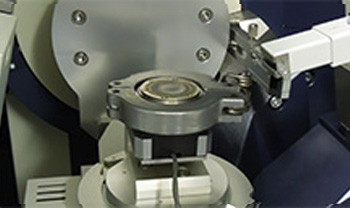
Overview of the In-situ XRD System -
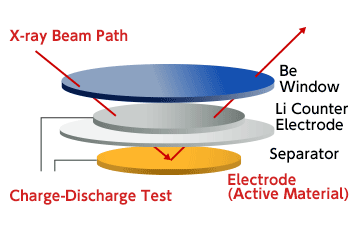
Schematic Illustration of the Analysis Method
In-situ Measurement Example of a Positive Electrode Material During Charge and Discharge
- In-situ XRD Measurement of a LiMn2O4 Positive Electrode
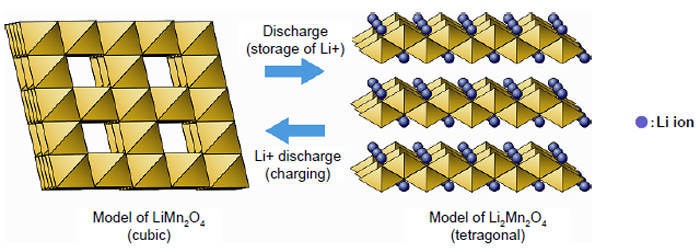
A simplified electrochemical cell was fabricated using LiMn2O4 as the positive electrode and metallic lithium as the negative electrode. The results of in-situ XRD measurements performed under an over-discharged condition are shown in Fig. 2.
Under the over-discharged condition, where an excessive amount of lithium ions is inserted into the positive electrode, the following structural change accompanied by a phase transition was observed:
LiMn2O4 (Cubic) +Li ⇔ Li2Mn2O4 (Tetragonal)
The in-situ XRD analysis confirmed that this phase transition causes a significant change in the crystal structure (Fig. 3).
-
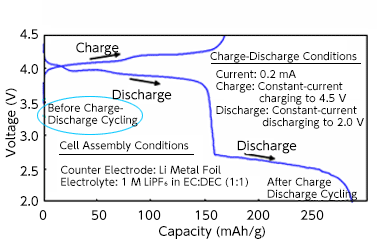
Fig. 1 Charge-Discharge Curve of the LiMn2O4 Positive Electrode -
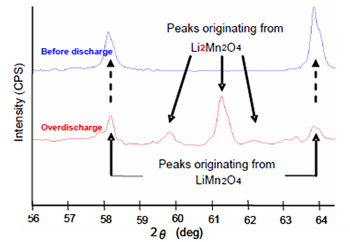
Fig. 2 In-situ XRD Results of the LiMn2O4 Positive Electrode
In-situ Thermal Analysis of LIB Electrodes - Highly Sensitive Detection of Localized Abnormal Regions -
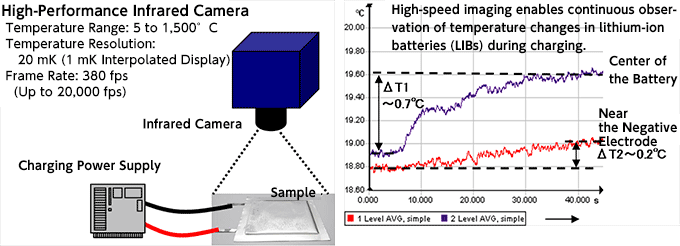
The heat generation behavior of lithium-ion rechargeable batteries (laminated-cell type) during charge and discharge can be measured in situ in real time using a high-performance infrared camera.
Abnormal heat-generating regions, such as internal short-circuit locations and high-resistance areas, can be detected with high sensitivity using the lock-in thermography method, achieving a temperature resolution of 0.001°C.
Localized regions can be identified with a spatial resolution of up to 10 µm.
Analysis Area
| 10 µm Resolution Lens | − | Field of View: Approx. 3.2 mm × 2.6 mm |
| 30 µm Resolution Lens | − | Field of View: Approx. 9.6 mm × 7.8 mm |
| 200 µm or Higher Resolution (Standard 27 mm Lens) |
− | Field of View: Approx. 6.4 mm × 5.1 mm or larger |
Measurement Concept and Examples of Thermal Analysis of Localized Electrode Regions
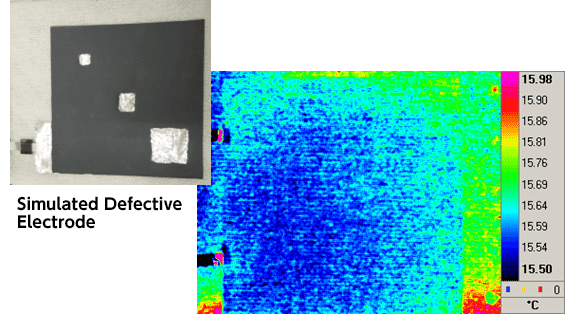
Defect Detection Example Using a Simulated Defective Battery
-
Overview of the Battery During Charge and Discharge -
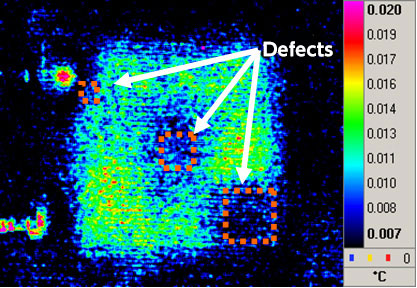
Analysis Results Obtained by the Lock-in Method
By removing noise components and improving
the temperature resolution to 0.001°C,
the lock-in method enables the detection of defective regions
that cannot be identified by conventional thermal imaging.
Evolved Gas Analysis
-
Gases generated inside a battery are one of the primary causes of battery swelling and degradation. These gases are produced through the oxidation, reduction, decomposition, or other chemical transformations of the electrolyte and electrode materials within the battery.
In-situ gas analysis during battery operation, such as charge-discharge cycling or overcharging, is an effective technique for investigating gas generation behavior unique to batteries. Understanding these internal gas evolution processes contributes to the improvement of battery performance and safety.
-
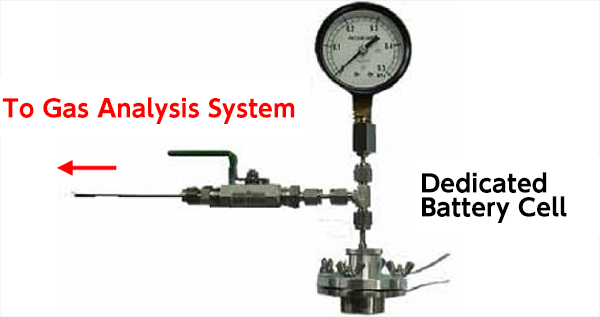
Overview of the In-situ Gas Analysis System
Analytical Method
Lithium-ion batteries are subjected to charge-discharge cycling or overcharge/over-discharge testing, and gases generated at specific stages are collected and analyzed.
- Thermal Desorption Gas Chromatography-Mass Spectrometry (TD-GC-MS) enables qualitative identification of trace gas species generated during battery operation.
- Gas Chromatography-Mass Spectrometry (GC-MS) and Gas Chromatography (GC) enable quantitative analysis of individual gas species down to the ppm level.
Analytical Example (Overcharge Testing and Gas Analysis of a Lithium-Ion Battery)
Results of cell temperature measurement during overcharging test and results of analysis of generated gas at end-point temperature (A point)
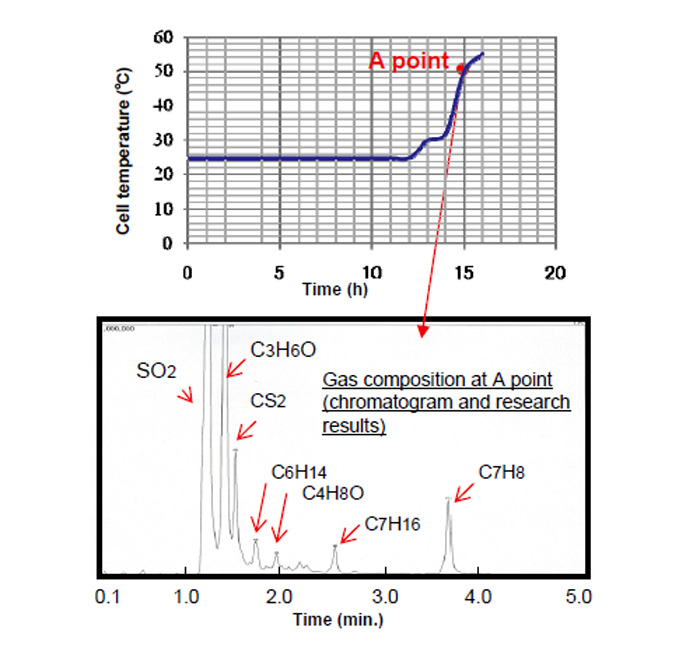
and the generated gas was analyzed at the end-point temperature.
In-situ Optical Microscopy Analysis
By using a dedicated cell equipped with an optical window, in-situ observation of microstructural changes during charge and discharge, such as lithium (Li) metal deposition, can be performed. The system also enables optical analyses, including Fourier Transform Infrared Spectroscopy (FT-IR).
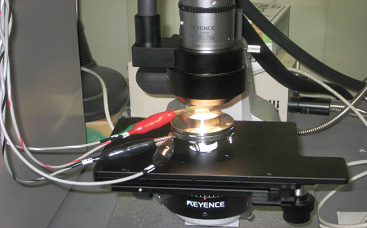
Example of Charge-Discharge Testing and In-situ Observation Using a Dedicated Cell (Two-Electrode Cell Configuration)
-
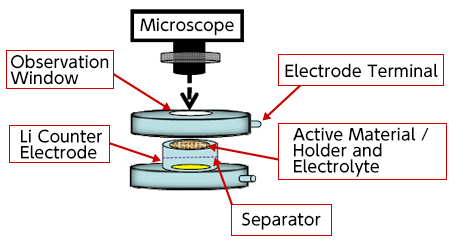
- Fix the positive or negative electrode active material to be observed in the cell holder.
- Install the counter electrode.
- Inject the electrolyte.
- Assemble the cell.
- Start the charge-discharge test.
-
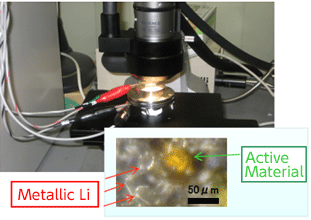
Observation of Metallic Lithium Deposition at the End of Charge-Discharge Cycling
(Continuous growth of particulate lithium deposits smaller than 1 µm can be observed.)